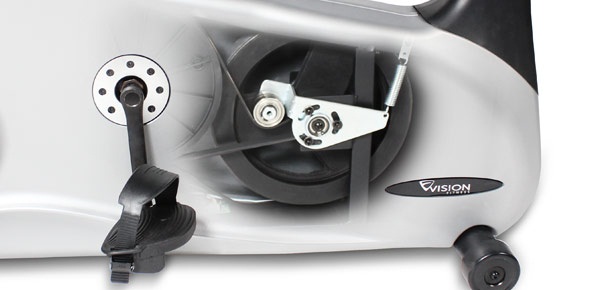
Exercise Bikes
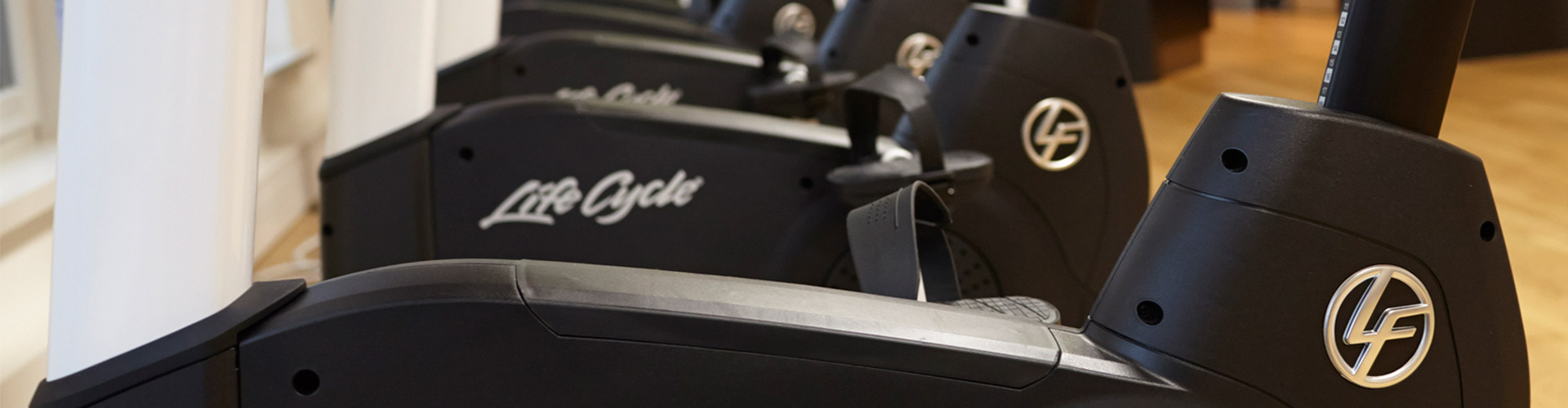
Frame:
Bike frames are constructed using various steel bars. The
structural integrity of these machines varies based on a number of factors_
Gauge of Steel- Not all bikes are created to withstand the
same type of usage and weight. One of the main factors in
determining bike durability is the gauge of steel. The lower the gauge, the more
durable the material. All of our bikes use heavy-duty steel frames that are
guaranteed for life and have an electro-static powder coating on the surface to
minimize rusting.
Welds vs. Bolts- These steel frame bars
are all connected using one of two methods, welds or bolts. Welding the bars
together will create a more durable result. Over time, nuts and bolts can loosen
and are therefore less dependable.
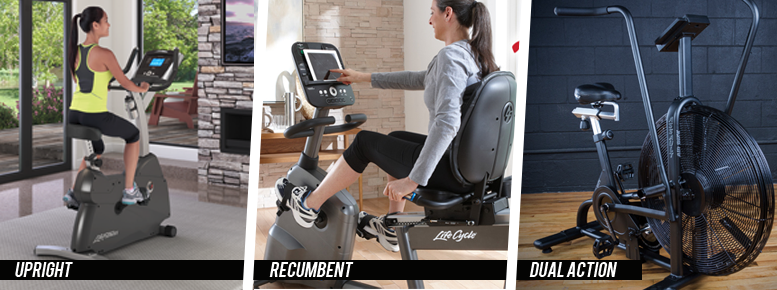
Types of Frames- Generally speaking,
there are three different styles of bike frames:
Upright- Upright bike frames most closely
simulate outdoor biking. These are the frames in which the user sits in an erect
position without a back pad. On these bikes the seat will adjust up and down,
but not front to back.
Recumbent- On a recumbent style bike the
user has the additional support of a back pad. On these bikes, the seat will
adjust front to back, but not up and down. Recumbent bikes have two types of
frames:
- Step-Thru- On a step-thru frame
there is a space between the console and the seat, allowing the user to more
easily get on and off of the bike.
- Traditional- No space exists. The
user has to climb over a portion of the frame to access the seat.
Dual-Action- Dual-action bikes are simply
a bike in which the upper and lower body parts are moving simultaneously. In
other words, they have a moving arm feature. Dual-action bikes can come in
either an upright or recumbent style.
Crank System:
A crank system is made up of both pedals and is connected
through the flywheel of the bike. Usually the flywheel portion of the crank
system is encased within the shrouds. There are two types of crank systems:
1-piece and 3-piece.
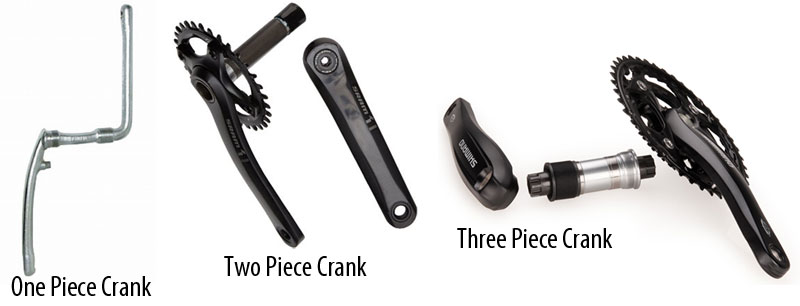
1-Piece: On a 1-piece crank system both
pedal arms are welded directly to the flywheel, thus making the crank system one
continuous piece.
3-Piece: On a 3-piece crank system, both
pedal arms are individually attached to the flywheel such that they can be
removed if necessary. These pedal arms slide over an axle shaft that is attached
to the flywheel. There are two types of axle shafts: a more rounded
octagon-shaped shaft and a square shaft. The square shaft mechanism is preferred
because it prevents slipping and is more durable.
Advantage- The 3-piece crank system is
the better of the two. The first advantage is that if something is to go wrong,
any of the three parts can individually be replaced without having to replace
the whole system. The second advantage is that the 3-piece crank system design
uses a higher quality ball-bearing mechanism, which will allow for a smoother,
longer-lasting machine.
Pedals- The final components of the crank
system are the pedals. Pedals are designed to be user friendly. They should have
straps that are easy to adjust and non-slip rubber coverings on them. Some
higher quality pedals also have self-leveling (often called self-balancing)
mechanisms built in. A self-leveling pedal is weighted on the bottom, such that
the pedal will not stay in an upside down position. Self-leveling pedals allow a
user to get on and off the bike easier than regular pedals.
Resistance System:
There are two ways to increase the intensity of your
biking workout. The first is to increase your speed, the second to increase
your resistance. There are three different systems used to change
resistance, all of which assume the flywheel has a magnetic charge to it.
Eddy Current- In an eddy current
resistance system there is a curved arm bar with magnets on it, evenly
spaced from the flywheel. As the user increases resistance, the arm bar gets
closer to the flywheel, as they decrease it, the arm
bar moves further away The resistance levels will increase
such that at a maximum resistance level there will still be a gap between the
arm bar and the flywheel. This helps to prevent friction and wearable parts,
which will ultimately increase the life expectancy of the machine.
Electromagnetic- In an electromagnetic resistance system
there are a series of magnets evenly spaced from the flywheel. In this system,
as the user increases the resistance, there is an increase in
the electromagnetic charge produced by these magnets. In this system the magnets
and the flywheel are again never in contact. The advantage of electromagnetic
over the eddy current system is that as the resistance changes, there are no
moving parts, making it a more reliable method.
Alternator- In a bike with an alternator
resistance system, the user is the bikes power source. Therefore, unlike the
eddy current and electromagnetic systems there are no cords or plugs, making it
the most reliable system. One potential draw back of an alternator system is
that the user must pedal at a
minimum R.P.M. pace in order to keep the bike powered.
Ranking- Starting with the most reliable
1)
Alternator
2)
Electromagnetic
3)
Eddy Current
Seat:
The two most important factors when determining the
best bike seat for a customer are comfort and durability. These do not
necessarily come one in the same. Every user is different. What is
comfortable for one user may be uncomfortable to the next. Like many other
biking features, these can be divided into recumbent and upright categories.
Recumbent- On a recumbent bike, both the seat and back
pad become pivotal in determining comfort. A main
functional selling feature on recumbent bikes is an adjustable lumbar
support. This works the exact same way as a car seat, and is put on the bike
to help provide additional back support with the
intention of keeping users on the bikes for a longer
period of time.
Upright- On an upright bike the seat
angle is extremely important. Some upright bike seats have a built in
"relief groove." This groove is designed to alleviate pressure from the
prostate, and makes for a much more efficient design.
Proper Seat Design- With proper seat support on a bike, a
rider can ride more comfortably, eliminate wasted energy and minimize fatigue.
An ergonomic design should have a convex shape with sweptback sides and a level
horn. A convex shape supports the body and decreases side-to-side motion, evenly
distributing body weight from left to right. The sweptback design reduces
rubbing and chaffing of the inner thigh and significantly increases knee and hip
range of motion. A horn parallel to the ground reduces the pressure on the
uro-genital areas of the body. Together, all these factors enhance the comfort
of the ride
and create a better overall riding experience.
K.O.P.S.-One of the most important factors in bike design
is the angle of the seat post. The seat post should be angled to achieve proper
"Knee Over Pedal Spindle" or KOPS. When the rider is seated comfortably with the
crank arm in the horizontal position, the knee should be directly in line with
the pedal's axle.
Research- Dr. Klatt and Kirchoff found
that for proper KOPS positioning, the seat post angle should be approximately
70-75 degrees to ensure proper knee positioning, reduce pressure on the knee,
and increase pedaling efficiency for all
types of users.
Positioning Criteria- The knee should
align with the pedal spindle in the forward most pedaling position.
Note: KOPS only pertains to upright
riding.
Electronics:
Bike electronics include more than just the number of
preset programs on a machine. The two most important electronic bike
features are the
communication between the upper and lower
board, and heart rate capabilities.
Communication- On a bike with any of
the resistance mechanisms previously discussed, there has to be some way for
the information to be passed from the console, down the neck and into the
workings of the flywheel and resistance mechanisms. This communication
system allows the resistance to change with the simple touch of a button.
Heart Rate- Similar to treadmills and
ellipticals, often heart rate capabilities are a key electronic component of
bikes. There are three different ways to track your heart rate, two of which
are touch-sensitive (or handheld), the other hands-free.
Analog Touch-Sensitive- An analog heart
rate reading is the least expensive and least accurate way to track your heart
rate. It is very susceptible to outside interference.
Digital Touch-Sensitive- A digital heart
rate reading, unlike an analog, has the ability to block many outside variables
(such as sweat and hand movement) to give users slightly more accurate results.
Telemetry Strap- The most efficient and accurate way for a
user to track their heart rate is through a telemetry strap.
This wireless strap wraps around your chest, right up against the skin. From
there, it sends a wireless readout directly to a heart rate receiver built into
the console top, very similar to a television remote. This is the most accurate
way to measure your heart rate because the reading is coming from directly up
against your heart (as opposed to your hands), and eliminates almost all
possible interference.
Flywheel:
The main component of a bike's inner workings is the
flywheel. The flywheel is the actual piece being propelled as the user
pedals.
Weight As expected, not all flywheels
are made with the same size, weight and design. Generally speaking, a
spinning bike will have an extremely heavy flywheel. One advantage of a
heavier flywheel is that it will typically yield a higher intensity, faster
paced workout. based on the theory of relativity (once it is in motion it
will stay in motion). A heavier flywheel will also, typically, make for a
smoother ride. It is very important to note how a flywheel is weighted. Just
because it may be heavier, does not necessarily mean that the weight is
balanced_ If it is not balanced the bike will not be as smooth.
Design- Many bike flywheels will have
a series of pits or lines carved into them. This is a much more effective
design because it changes the airflow patterns around the wheel.
Belt vs. Chain Driven- Stationary bikes are driven
using one of two mechanisms, chains or belts. Chain driven bikes are
very similar to the outdoor bike that you may have ridden as a kid.
They require constant maintenance and
can make a mess when greasing or oiling. Belt driven
systems will be smoother, quieter and require less maintenance. thus making them
much more reliable, G&G Fitness only carries bikes with belts made from a
synthetic Poly-Vinyl material,